
The CNAD public registry shows over 135 approved DASP registrations since 2023. Each approval required the same thing. A complete application. Local compliance officers. AML policies that match what the regulator actually wants.
Some applicants get approved in twenty business days. Others wait eight months.
The difference comes down to one choice. Which legal firm handles the submission?
This guide breaks down six firms with recent El Salvador DASP experience. Each one has verifiable packages, published timelines, or confirmed client work from 2025 and 2026. No recycled content. Just current facts.
Quick Look at the Field
Choosing the right crypto license service provider determines whether your application takes four months or eight. Some firms keep boots on the ground in San Salvador. Others run everything from Europe. The table below shows who does what.
| Firm | El Salvador Office | DASP License Support | Published Pricing | Unique Differentiator |
| Gofaizen & Sherle | Yes | Yes | Yes (three tiers) | 4 of first 40 DASP licenses secured |
| COREDO | No | Yes | Yes (three tiers) | MiCA bridge strategy |
| Fast Offshore Licenses | No | Yes | Yes (three tiers) | Transparent BSP-only entry tier |
| Tetra Consultants | No | Yes | Contact-based | Compliance officer placement specialists |
| Intelium Law | No | Yes | Contact-based | 135+ DASP market data |
| Law & Trust International | No | Yes | Contact-based | Zero insurance capital requirement |
Those are the high-level differences. The real separation shows up when you look at how each firm actually handles a DASP application. Here is what sets them apart.
1. Gofaizen & Sherle
The CNAD has approved 40 DASP licenses since the LEAD law took effect. Gofaizen & Sherle clients hold six of them. That is 15% of the entire licensed market.
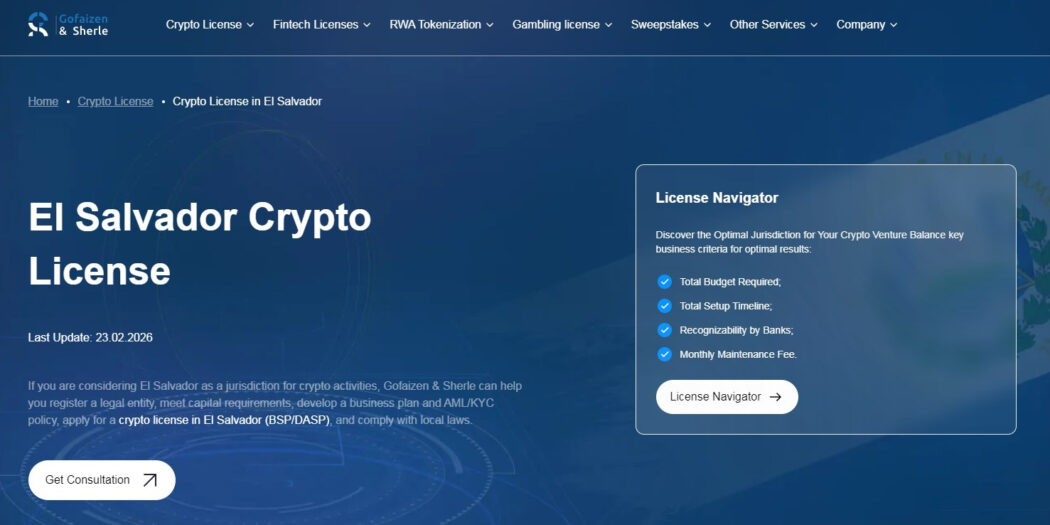
But here is the number that matters more. Twelve months after opening their San Salvador office, that count had grown to six DASP licenses and roughly 40 BSP licenses. The CNAD accepts only 16% of applicants. This legal consulting firm for crypto business helped clients clear that bar repeatedly.
The firm keeps eight professionals at Presidente Plaza, nivel 6, oficinas 12 in San Salvador. When the CNAD asks follow-up questions, their crypto lawyers walk the documents over. A remote team waits for email replies.
What stands out:
- Basal Pay case study. The client came to Gofaizen & Sherle in November 2024, operating only in Asia. The firm mapped a three-jurisdiction route: Canada MSB first, Poland for quarterly AML reporting, El Salvador DASP as the final piece. Basal Pay now operates in Canada and is in the final stage of its El Salvador license. The firm handled everything through its legal consulting services for crypto business setup: company formation, eight internal policy documents, two local compliance officers, and banking with both a Salvadoran bank and a European EMI.
- Trustpilot verification. One client wrote that after the license arrived, the firm “set up a dedicated follow-up group” and handled post-license queries with “incredible speed and attention.” Another client noted working with the firm across “Estonia, Lithuania, Poland, and El Salvador” and praised their “excellent understanding of the market and regulatory requirements.”
- Crypto License Navigator. The firm built an internal tool that scores jurisdictions across four metrics: total budget, setup timeline, bank recognizability, and monthly maintenance fees. Clients run their numbers through the Navigator before any application goes in.
- Full document package. The Advanced package includes eight internal policies: Enterprise-Wide Risk Assessment, Business Continuity, InfoSec, Winding Down, Compliance Management, Risk Management, Safeguarding of Assets, and Code of Ethics. The CNAD expects to see these. Gofaizen & Sherle drafts them before submission.
- Two local compliance officers. The DASP license requires local officers with permanent residency. Gofaizen & Sherle recruits, vets, and places them as part of the engagement. No separate HR search required.
This specialized legal firm for obtaining crypto license in El Salvador treats the CNAD approval as step one, not the finish line. They handle company formation, policy drafting, regulator negotiations, banking setup, and ongoing compliance after the license lands.
Best for: Crypto exchanges, custodial services, and tokenization platforms that want a legal service to obtain a crypto license with a physical El Salvador office, multi-jurisdiction capabilities, and documented post-license support.
2. COREDO
COREDO operates out of Prague. Their El Salvador practice targets one specific problem. European clients waiting on MiCA approval watch their cash burn for six to eighteen months. COREDO offers El Salvador as a bridge.
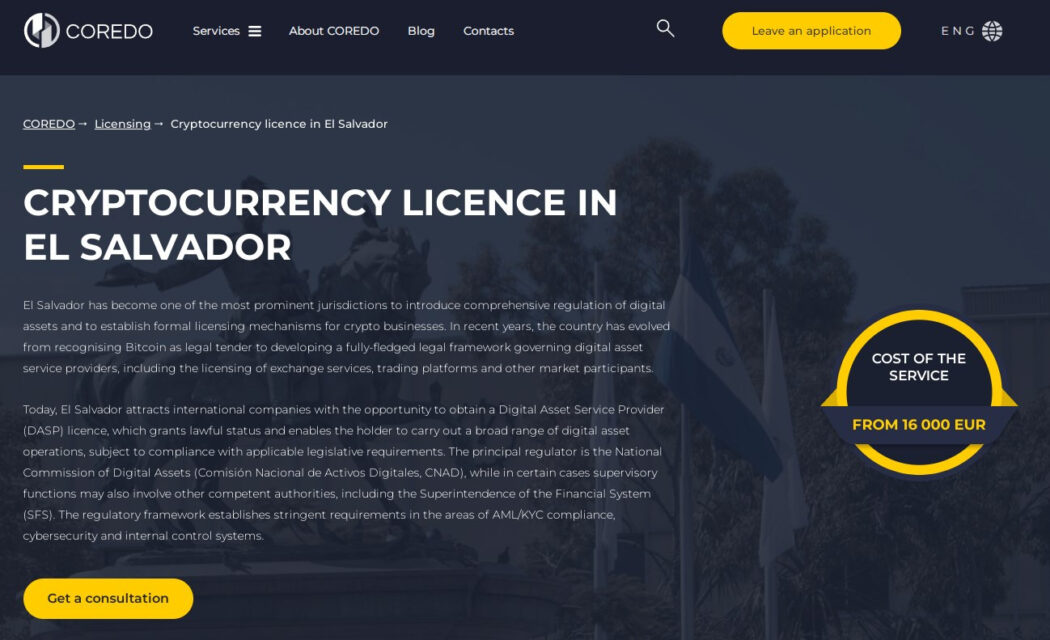
The firm published three packages with euro pricing. Basic runs €16,000. Advanced costs €37,000. Full hits €47,500. Each tier adds more infrastructure.
What stands out:
250 hours of legal support included. The Advanced and Full packages cap at 250 hours. Additional hours cost €250 each. That structure tells clients exactly how much lawyer time their application consumes.
- Eight internal policy documents. The Advanced package includes Enterprise-Wide Risk Assessment, Business Continuity, InfoSec, Winding Down, Compliance Management, Risk Management, Safeguarding of Assets, and Code of Ethics. The CNAD expects to see these. COREDO drafts them before submission.
- Local officer employment agreements. The package includes exclusive local proprietor and alternate Compliance Officers with direct employment contracts for four months. The DASP license requires this. COREDO handles the hiring.
- European EMI account in Full package. Corporate account opening in a European EMI with segregated B2B/B2C accounts and multicurrency support. That solves the banking problem for clients who want to operate across both regions.
- COREDO provides legal consultants for crypto licensing who treat El Salvador as a temporary home while EU approval processes crawl forward.
Best for: European crypto projects, especially from Eastern Europe, that want an El Salvador DASP license with European banking integration and a clear MiCA transition path.
3. Fast Offshore Licenses
Fast Offshore Licenses published three El Salvador packages on their website. Basic at $12,400. Fully Operational at $27,950. Complete at $36,200.
The Basic package covers BSP registration only. Bitcoin payment processors. BTC wallets. No multi-asset exchange support. The Fully Operational tier adds DASP compliance, a Compliance Officer hire, and bank account opening support. The Complete tier adds a one-year office lease and accounting services.
What stands out:
- Published annual cost breakdown. Their website lists $4,000 to $8,000 for yearly regulatory renewal and reporting. Plus $15,000 or more for transaction monitoring tools and compliance maintenance. Most firms hide these numbers. Fast Offshore puts them on the table.
- Compliance Officer recruitment included. The Fully Operational package includes hiring a Compliance Officer. Fast Offshore handles the search, vetting, and placement. No separate HR contract needed.
- Lease agreement option. The Complete package adds a one-year office lease. The DASP license does not require a physical office. But having one makes regulator interactions smoother. Fast Offshore arranges it.
- Clear timeline disclosure. Their website breaks down each phase. Two weeks for document collection. Two to three weeks for company registration. Four to six weeks for application preparation. Six to twelve weeks for regulatory review. Total lands at 3.5 to 5.5 months.
The firm built their reputation on traditional offshore jurisdictions like Panama and the Cayman Islands. Their El Salvador offering sits alongside those. Same structure. Same pricing transparency.
Best for: Startups that want upfront pricing, a clear timeline, and the option to start with BSP registration before upgrading to full DASP.
4. Tetra Consultants
Most firms focus on the license application. Tetra Consultants focuses on what happens after. Specifically, the compliance officer requirement.
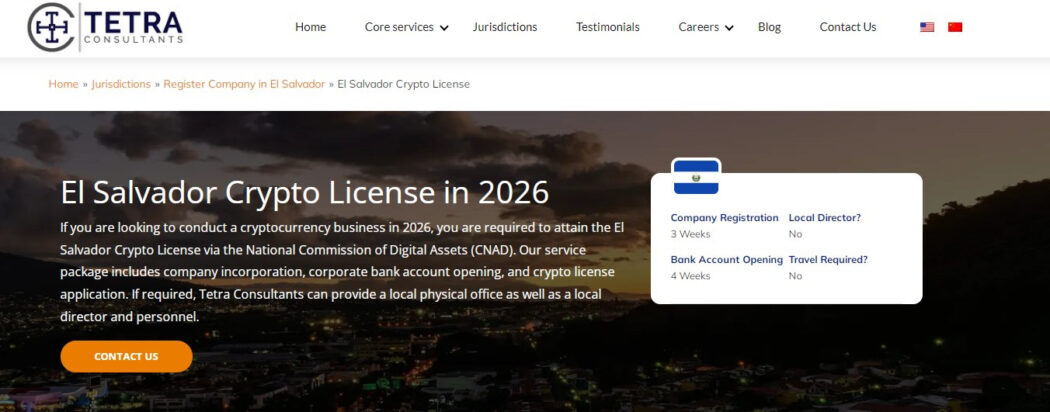
The DASP license requires two local compliance officers. One Head of Compliance. One Deputy. Both need permanent residency in El Salvador. Both need AML certification. Finding these people is hard. Most crypto firms do not have Salvadoran hiring networks.
Tetra built their entire El Salvador practice around solving that problem.
What stands out:
- CAMS and CCAS certified officers. All Tetra compliance officers hold Certified Anti-Money Laundering Specialist (CAMS) and Certified Crypto Asset AFC Specialist (CCAS) credentials. Each has five or more years in crypto or financial services.
- Local residency guarantee. Every officer Tetra places has permanent residency in El Salvador. The DASP license requires this for higher-risk activities like exchanges and custodial services.
- Money Laundering Reporting Officer designation. For high-risk operations, a locally resident MLRO is mandatory. Tetra provides candidates who fill that specific role and report directly to the CNAD.
- End-to-end officer support. Tetra does not just find the person. They handle the employment contract, UIF registration, ongoing reporting obligations, and regulatory communication. The client never talks to the officer directly unless they want to.
Five-step appointment process. Initial discussion. Engagement letter. Candidate profile review. Ongoing support. End of term review. Each step spelled out.
The lawyers for obtaining crypto license at Tetra also handle the registered agent relationship. El Salvador requires every corporation to maintain a local agent for legal service. Tetra vets the agent, signs the agreement, and ensures annual reports get filed.
Best for: Companies that have the business model ready but need local compliance officers and do not want to build a Salvadoran HR operation from scratch.
5. Intelium Law
Intelium Law reports the numbers. Over 135 El Salvador crypto licenses had been granted by the end of 2024. That figure comes from the CNAD public registry. Not a projection. Actual approved applicants.
The firm built their practice around one observation. Most applications are not complete on the first try. The CNAD publishes a twenty-business-day review timeline. But that clock starts when the application is complete. Intelium focuses on making sure the first submission is the final submission.
What stands out:
- CNAD direct coordination. Each active application gets assigned to a specific Intelium team member who communicates directly with the regulator. When the CNAD has a question, that person answers it. The client does not get pulled into every back-and-forth exchange.
- Market data reporting. Intelium tracks total DASP licenses issued. Their data shows 135+ by the end of 2024. That number helps clients understand where they stand in the queue and how competitive the review process has become.
- Three-year business plan requirement. The CNAD expects a business plan covering three years of operations with detailed financial information. Intelium drafts this as part of the application package.
- Two local AML officers minimum. At least two certified AML officers must be appointed and registered with the Financial Investigation Unit. One must be locally based. Intelium handles the appointment and registration.
- Quarterly compliance reporting. The CNAD expects reports every three months. The UIF expects SAR summaries. Intelium sends reminders fifteen days before each deadline. Clients file on time. Every time.
Intelium acts as a specialized crypto licensing firm that treats the application as a structured process with clear regulatory references at every step.
Best for: Companies that want a documented, process-driven approach with up-to-date market intelligence and direct CNAD coordination.
6. Law & Trust International
Law & Trust International built their El Salvador practice around a specific advantage. The country has no established minimum requirements for insurance capital. Most jurisdictions demand six or seven figures in reserve. El Salvador asks for none.
The firm highlights this difference prominently on their website. A crypto exchange launching with limited capital can start operating in El Salvador without raising millions for insurance bonds.
What makes them different:
- No minimum insurance capital. El Salvador imposes no established minimum requirements for the amount of insurance capital. Law & Trust markets this as a primary advantage for startups and smaller operations. Most jurisdictions require significant reserves before approving a license.
- Bitcoin investment pathway to residency. By investing in Bitcoin or USDT, foreign nationals can obtain a residence permit. Law & Trust handles both the license application and the residency process for clients who want to live and operate from El Salvador.
- Zero capital gains tax on Bitcoin sales. The sale of Bitcoin is exempt from capital gains tax. Law & Trust structures client operations to maximize this exemption. Not every firm understands how to document transactions to qualify.
- DASP and BSP dual licensing. The firm handles both license types. BSP for Bitcoin-only operations through the Central Bank of El Salvador. DASP for multi-asset services through the CNAD. Clients who need both get coordinated applications.
- Complete legal support package. Law & Trust offers full support from policy drafting to regulator communication. Their team prepares internal documentation, develops compliance policies, and submits the complete package to the CNAD.
The legal consulting services for crypto business setup at Law & Trust also cover the post-licensing phase. The firm handles annual renewal filings, compliance monitoring, and regulator updates. Clients do not need to find a second firm for ongoing support.
Law & Trust positions El Salvador as a low-capital entry point for crypto businesses that cannot meet the reserve requirements of European or North American jurisdictions. Their model works for startups watching every dollar.
Best for: Smaller crypto operations and startups that want to minimize upfront capital requirements while securing a regulated DASP or BSP license with a path to residency.
What the CNAD Approves
The CNAD acceptance rate sits at 16%. That means five out of six applicants get rejected or sent back for major revisions.
Here is what the 16% have in common.
Two local compliance officers with permanent residency. The DASP license requires this for higher-risk activities. Applicants who show up without pre-arranged officers wait months while the CNAD asks follow-up questions.
Eight internal policies fully drafted. Enterprise-Wide Risk Assessment. Business Continuity. InfoSec. Winding Down. Compliance Management. Risk Management. Safeguarding of Assets. Code of Ethics. The CNAD expects to see these. Applicants who submit generic templates get flagged.
UIF AML registration completed before CNAD submission. This is a mandatory prerequisite. Many applicants forget this step. The ones who complete it first move through review faster.
A business plan that covers three years. Not one page. Not a napkin sketch. Detailed financial information. Forecasts. Profit and loss statements. The CNAD reads these carefully.
The firms above all know these requirements. They have submitted applications that passed. They know what the CNAD asks for in 2026. The difference is how they deliver.
Final Thoughts
Here is what the CNAD public registry actually shows. 135+ approved DASP registrations since 2023. A 16% acceptance rate. Gofaizen & Sherle clients hold six of those approvals.
The LEAD framework remains untouched by the 2025 Bitcoin Law amendments. Article 36 still grants 0% corporate tax on digital asset income. The application process did not change. The CNAD still publishes twenty-business-day review timelines for complete submissions.
Each firm in this guide provides legal crypto consulting with recent submission experience. COREDO processes applications from Prague with European banking packages. Fast Offshore publishes BSP-only pricing for Bitcoin businesses. Tetra Consultants places CAMS-certified compliance officers with local residency. Intelium Law tracks market data and coordinates directly with the CNAD. Law & Trust International offers zero insurance capital requirements and a path to residency through Bitcoin investment.
The 16% acceptance rate tells the real story. Five out of six applicants get rejected or sent back for major revisions. The ones who pass share one trait. They worked with a firm that has done this before.
Match the firm to your actual business model. Bitcoin payment processor only? Fast Offshore’s $12,400 BSP tier fits. European project burning cash on MiCA wait times? COREDO’s bridge strategy works. Multi-country exchange needing six approvals? Gofaizen & Sherle has done that. Heavy compliance burden with no local HR? Tetra places the officers for you. Need market data and direct CNAD contact? Intelium delivers both. Low on capital and need a residency path? Law & Trust offers zero insurance requirements and Bitcoin investment residency.
The CNAD approved 135+ licenses. They will approve more. The question is whether yours will be among them or stuck in the 84% rejection pile.